Serengeti National Park
A UNESCO World Heritage Site of vast plains where the Great Migration crosses seasonally—wildebeest, zebra, and predators in one of Africa’s most iconic landscapes.
Where Is Serengeti Located?
Situated in the northern region of Tanzania, the golden plains of Serengeti National Park stretch for almost 15,000 square kilometres. The park is located completely in the northeastern part of the Simiyu region and the eastern Mara region.
The landscapes of the Serengeti Ecosystem are extremely varied. They range from savannahs and open grasslands to hilly woodlands and riverine forests. This diversity is because of the extreme weather conditions, in particular the combination of heat and wind.
The habitats of the Serengeti are believed to have originated from a series of volcanoes. The volcanic activity helped shape the features of the ecosystem by adding craters and mountains to the surroundings.
The Mara River flows through the Kenyan highlands to Lake Victoria, where terrific migration crossings happen. This is the only river in the ecosystem that flows permanently, and it plays a key role in many Serengeti Safari Tours.
The Serengeti's diverse ecosystem is home to hundreds of native and non-native plant species spread across its vast landscape.
Over 300 species of plants are recorded in Serengeti.
15 alien species of plant are distributed throughout the park as well.
Acacia trees and sausage trees are the two plants that Serengeti is famous for. When you’re out on game drives in the vast savannahs, you’ll be able to see them right from your safari vehicle.
Woodlands are commonly found in the northern region of Serengeti, as this section is covered by hills.
Lush savannahs with some acacia trees, make up the surroundings of the Western Corridor. The Grumeti River also makes its way through these surroundings.
Birdwatching Experience in Serengeti
Even if you’re not into birds now, a Serengeti birdwatching experience might change that. With over 500 bird species, the park is a true haven for birders.
Highlights include:
Secretary bird
Kori bustard
Green and yellow Fischer’s lovebird
The Serengeti-Mara ecosystem is home to five endemic species found nowhere else on Earth.
For the best birdwatching experience, visit between November and April, during nesting season.
Migratory birds from Europe and North Africa are also present during this time.
Want a more extensive birding trip? Combine your Serengeti Trip with a visit to Lake Manyara.
Welcome to Serengeti National Park
The word Serengeti means endless plains in the Maa language (Maasai), and people who live around the Serengeti national park. The park is covered with grassland plains and in the middle of it offers views of distant landscapes (plains). When on safari the only feeling you can get is the typical African wilderness experience. Serengeti is an Award-winning, best national park for an African safari. The park upgraded from a game reserve (big game hunting ground) to a National park in the year 1951 (the first national park in Tanzania), and is located in northern Tanzania and extends to southwestern Kenya.

Serengeti national park covers an area of 5,700 square miles (14,763 square km) and is normally referred to as the great grassland range in Africa as well as vachellia woodland. The park extends 100 miles (160 km) southeast from the shores of Lake Victoria and, in its eastern part 100 miles (160 km) south of the Kenya - Tanzania border. The Serengeti-Mara ecosystem encompasses several protected areas like the Serengeti national park, the Mara national reserve in Kenya, and a number of game reserves and conservation areas (Ngorongoro) that surround the area.

Serengeti National Park
Map
Area : 14,763 sq. km. (5,700 sq. miles)
Established in : 1951
Designated as a UNESCO World Heritage Site in : 1981
Coordinates : 2.3333° S, 34.8333° E
Opening Hours : 6 am to 6 pm (open every day)
Entrance Fees : For Adults: $70. For Children (between the ages of 5 to 15): $20.
Serengeti Safari Regions Explained
The entire ecosystem of Serengeti National Park is a region of amazing biodiversity. If you want to have a safari in the park, you must know what the different areas have in store. So, the following are the primary five safari areas in Serengeti National Park:
The Seronera Region
The southeastern area of Seronera is the centre of wildlife viewing in the wet season, from December to April. Huge herds of wildebeests gather here during this time. This makes for amazing predator action, and Seronera is widely known as the predator capital of Tanzania.
Lion sightings along the Seronera River are almost guaranteed.
The riverbanks are home to some of the densest populations of leopards. They can be seen on top of the sausage trees.
Some patience combined with a bit of luck may also result in sightings of tree-climbing lions.
The region is also home to black rhinos and many herbivores.
The plains around the Kamuyo Hills are a great site to witness cheetahs, elephants, and spotted hyenas.
Ndutu Plains
If you want to experience the essence of classic Tanzania Safari Packages, then heading to the Ndutu Plains will be perfect. These vast open grasslands are home to several animals. Giant herds of wildebeests and zebras can be seen during the wet season.
The Ndutu Plains is also a site of the calving season, where wildebeests give birth between January and March.
The woodlands around Lake Ndutu offer shelter to an extensive range of birds, with Fischer’s lovebird being one of the most fascinating sights.
The southeastern plains are surrounded by many clusters of kopjes.
These kopjes provide habitat for wildlife like klipspringers, rock hyrax, leopards, raptors, and more.
Lions also use the kopjes as a vantage point to survey the plains. The Simba Kopjes is a great place to see these majestic kings of the golden savannahs.

Grumeti Game Reserve
In the western reaches of the Serengeti lies an undiscovered gem – the Grumeti Game Reserve. This reserve is located in a beautiful and remote corner of the park. And because of this remoteness, the game-viewing experience is heightened.
The number of people who can stay in the camps surrounding the region is limited.
As a result, the number of crowds is fewer—great news if you want a private safari experience.
Only a few areas in the Serengeti offer walking safaris, which makes walking safaris in the Grumeti Game Reserve a special treat.
You’ll be able to enjoy hours on foot with your safari guide and learn about the birds and smaller animals in the area.
Wildlife viewing in the reserve is great throughout the year.
The savannahs in the southern region of the Grumeti River support a range of wildlife—wildebeests, giraffes, zebras, and lions.
The remote surroundings north of the river are a great place to see cheetahs.
Lobo Hills and the Northern Plains
The northern plains of the Serengeti are undiscovered, beautifully scenic, and remote compared to the plains of the Southern Serengeti. The region stretches from the Lobo Hills to the Seronera and is characterized by rolling green hills.
This landscape is a pleasant departure from the flatter plains of the southern region.
Because the northern plains are much denser in terms of vegetation, animals are harder to spot.
But the northern plains have fewer crowds, so it should certainly be considered despite the drawbacks.
You may even get to experience a game drive without another vehicle in sight.
Just picture cruising across a landscape of open grasslands with some dense woodlands sprinkled in—a serene experience for sure.
The Western Corridor
The Serengeti Western Corridor is an expanse of land following the course of the Grumeti River from Central Serengeti out towards Lake Victoria. The foremost feature of the Western Corridor is a pair of rivers – the Grumeti River and the Mbalageti River.
The habitat of this region is mostly a combination of woodlands, dotted with dense whistling thorns and open savannahs.
These habitats are home to a substantial range of wildlife like elephants, wildebeests, lions, zebras, and several species of antelopes.
The Western Corridor is a wonderful portion of the Serengeti that supports a spectrum of resident wildlife all year round.
From May to July, the migrating herds pass through this region, making it a highlight of Serengeti Migration Safaris.
What Is the Great Migration in Serengeti?
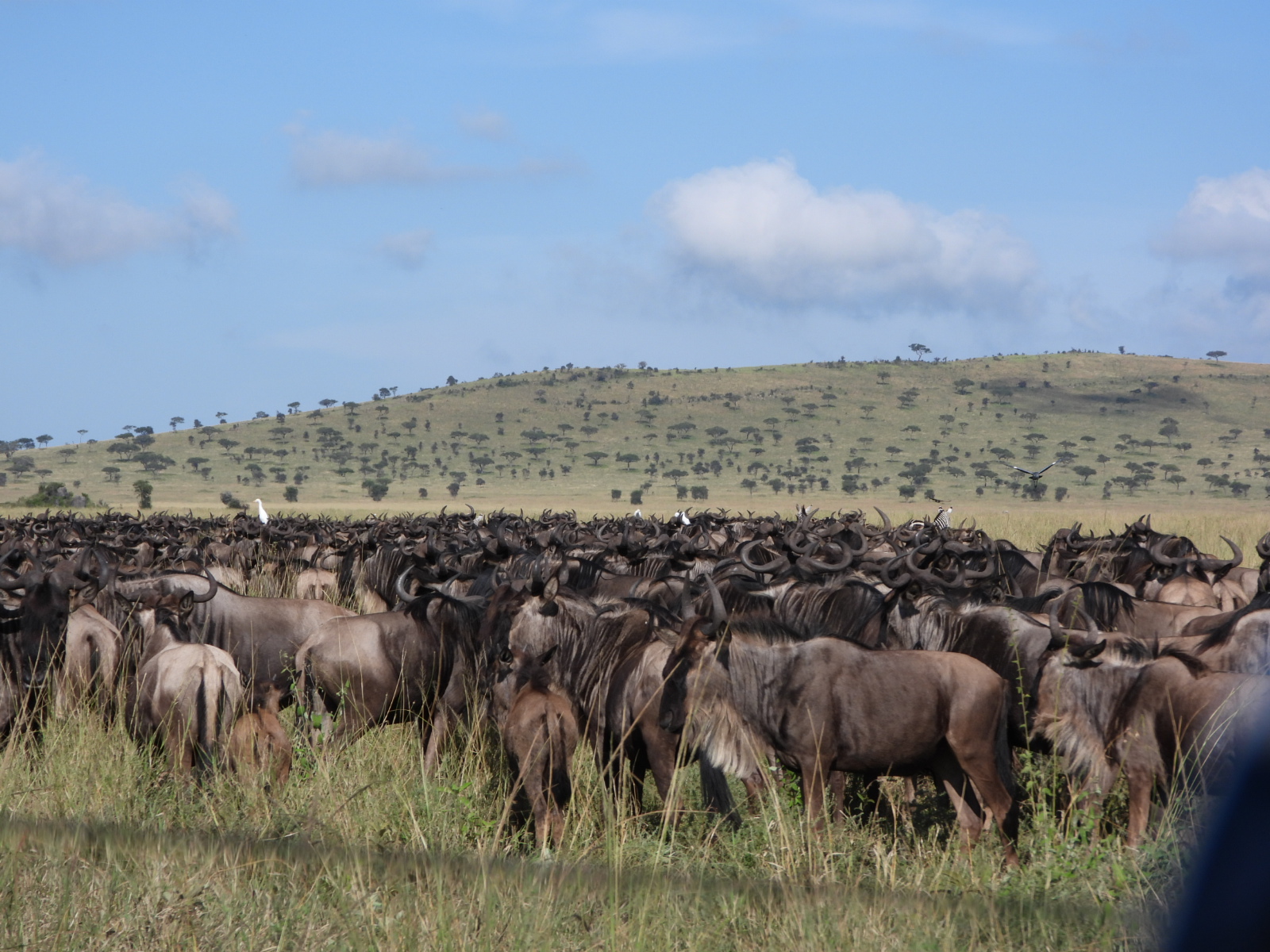
In short, the Great Migration is the race of life for the herbivores of the Serengeti. It is the greatest show on our planet, and you’ll get the opportunity to witness this stunning spectacle on Safari in Serengeti.
The expedition of the main cast in the migration – the two million wildebeests begin in Southern Serengeti. This happens after the mass calving season, in January and March. This is the favourite season for all of the safari-goers and the atmosphere during this time is filled with new life and exciting action.

Why does the Great Migration happen?
The 800-kilometre journey of the supersized herds of wildebeests, zebras, and gazelles is the largest mammal migration on Earth. The timing of the migration corresponds with the wet season when the short grass plains turn a lush green.
The region is much safer because the shorter grass offers a great place for calving.
This is because predators can be easily spotted, so if the animals sense any danger, they have plenty of time to run away.
But, the plains soon dry up and the wildebeests have to move in search of greener meadows in the Western Corridor.
Serengeti’s northern ecosystem receives the highest amount of rainfall, and yet the grasses are the least nutritious. This is the dry season getaway for the herds, which is until the grass transforms greener again. The result is a clockwise movement from the south, west, north, and finally back again to the south.
The Annual Cycle of the Great Migration
Although some variations happen at different points, the migration in Serengeti National Park follows a fairly predictable annual cycle. This is dictated by the local rainfall patterns. The following periods are the cycles of the Serengeti Great Migration Safari.
From December to April
The main calving grounds are in the Seronera region. Wildebeests stick around this area until the long rains (around late April and early May). The great news is that this section of the Serengeti is easily accessible and the surroundings are wonderfully vibrant.
February is the calving season in the Ndutu plains.
Several wildebeests and zebras give birth to calves and this spectacle works as a magnet for the predators.
Then, in late March and early April, the herds move again in search of greener grasses.
Witnessing the actual migration in this period may be a bit challenging, but you’ll for sure see large herds on the move.
From May to July
These months see the wildebeests getting ready for their 800-kilometre-long trek. This is the time when you’ll get the chance to see one of the greatest phenomena on the planet. I.e. more than a million wildebeests marching in a column up to 40 km long.
During this journey, the herds move towards the Western Corridor.
This is where they face the major challenge—crossing the Grumeti River.
Many animals perish here, as they are awaited by the deadliest crocodiles.
This is the circle of life, where the weak ones have no place in the natural course of the world.

From August to September
After tackling the battle of the Grumeti River, the herds move further north and come against the greatest battle for survival. This is the Mara River Crossings. So many iconic pictures of this spectacle have been taken here.
Whilst on Safari in Serengeti Tanzania, you’ll witness these herds tumble into the great Mara River, where some of the deadliest crocodiles await attack.
After the Mara crossings, the herds move towards the northwestern plains and eventually to the Masai Mara National Reserve in Kenya.
An interesting thing that happens is about half of the herd stays on the Tanzanian side, in the Mara Serengeti region.
In October and November
This period sees the herd cross the northern plains and Lobo Hills region of the Serengeti. This area is rarely visited, so if you want to experience the Great Migration in complete exclusivity, then this would be the time.
The herds return to the short grass plains of the calving grounds around the Ndutu region in late November.
And from here, the Great Migration begins all over again.
Top Safari Experiences in Serengeti National Park
Endless golden savannahs, majestic creatures, the greatest show on our planet, and some of the most gorgeous sunsets you’ll ever get the pleasure to witness! All of this and much more await you on Safaris In Serengeti National Park.
Key Facts About Serengeti National Park
The endless plains of the Serengeti are teeming with all kinds of natural splendours that you can imagine. Want panoramic landscapes? You’ve got it! Some of the most diverse wildlife ever? No worries! Luxurious accommodations and amenities? It’s covered!
A welcoming place for couples, groups, backpackers, and families alike – the Serengeti is perfect for everyone! So, with that in mind, the following are some of the major takeaways of Safaris in Serengeti National Park:
A place where wildlife flourishes, with over 2 million hooved animals, 400 lions, 1000 leopards, 500 cheetahs, and more than 500 species of birds.
Picture the perfect destination for safaris – with exhilarating game drives, and walking safaris!
The largest wildlife spectacle on our planet awaits – The Great Wildebeest Migration!
A private and remote safari – in the undiscovered plains of Grumeti Game Reserve.
Unparalleled aerial views of the surroundings of the Serengeti – On Hot Air Balloon Safaris!
Visit the site of our ancient ancestors, the cradle of humanity- the Olduvai Gorge!
See the lazy giants bathing, feeding, and relaxing – at the Hippos Retina Pool!
The flowing rivers, towering mountains and gorges of the Seronera River Valley.
Experience the way of life of the semi-nomadic Maasai communities – On cultural tours.
Get transported right into the Lion King – on a visit to the Moru Kopjes.
Witness the calving season in the Ndutu Plains – and appreciate the discovery of new life!
Exceptional birdwatching experience – see several endemic birds along with the secretary bird and Kori bustards.
Spot the wildlife of the Serengeti when it’s most active – on morning safaris!
The life force of the wildlife – the rich flora of Serengeti. See acacia trees, sausage trees, as well as umbrella trees, and yellow-fever trees on game drives.